
Have a news tip for us?
Just email . Ideas for stories, links to interesting articles, and press releases are welcome.

The latest movie theater news and updates
-
December 16, 2016
Aledo, IL - Aledo family has fun reopening historic movie theater

From qconline.com: At the holidays, it’s a pleasure to see a family-friendly Christmas movie in a single-screen theater, with concessions, and not have to take a second mortgage to do so.
Since this month started, that’s been possible here in the seat of Mercer County, as Aledo native Dan Mellgren and his wife, Michelle, reopened the historic Aledo Opera House. The 1904 building — with 414 seats — had been closed for two years.
“This town needs some entertainment,” Dan said recently. “We didn’t have to do anything. The building’s here, the screen’s here. Everything was here.”
“We’re gonna gear it toward the junior-high age group,” he said. “Parents are looking for a place to drop their kids for a couple hours. That’s what it was when I was a kid — here’s 10 bucks and we’ll see ya in a couple hours.”
Dan said it last closed because of the costs for licensing each movie. The Mellgrens lease the theater — and since Aug. 1, The Slammer Bed & Breakfast — from Dick and Jennie Maynard, and run the businesses.
“This building has been a million different things,” Dan said of Aledo Opera House, including a roller rink and a basketball court. “Nothing’s really changed in here,” he said, noting the main difference since he was a kid was that three rows were removed to make more leg room between rows.
The theater opened on Feb. 26, 1904, with a production of the play “Quincy Adams Sawyer.” It was first used as a movie theater in 1909, and also has served as a church. While operating as a movie house in the ‘70s and '80s (when Mr. Mellgren grew up here), it closed in 1997.
An October 2000 fire in a neighboring building damaged the theater, and a renovated opera house reopened in 2002. It closed once before during the past decade.
“It’s a historic building in our downtown area, been part of our community for 100 years. It’s really an asset,” said Tarah Sipes, Aledo’s economic development coordinator. “It’s an amenity for our residents; there’s a big nostalgia factor as well. I also spent time there in my youth. The movie theater was a great place to go.”
She’s working with the city administrator and Main Street director about securing private funding to get digital projection needed for new films.
“I’m excited; the Mellgrens do have quite a bit of energy and passion for what they’re doing, which makes a big difference,” Ms. Sipes said. “If we can harness their energy, make more it visible, I hope that we can get things rolling in the same direction.”
Dan met Michelle when they attended Southern Illinois University. While they didn’t graduate, Dan worked in management with AirTran airlines for 10 years. They’ve been married since 2000. They have two children — 14-year-old Emma, and 11-year-old Colin.
The Mellgrens lived in the Miami, Fla., area for eight years; he left AirTran in 2010, and started working as vice president for a company that sold merchandise to duty-free stores.
“I left that because I was gone nine months out of the year,” Dan said, noting he traveled all over the Caribbean.
When they moved back to Aledo about two years ago, he started a “pay it forward” gift business.
“This is the best way to slow it down — move to a small town, tie yourself to some big anchors,” Dan said of the historic landmarks they manage. “The nice part of it is, the kids can be part of it,” Michelle said, noting their kids help out.
“I want my kids to have a little bit of what I had growing up,” Dan said. “This was an easy fix. With the Slammer, I usually do the morning stuff, so it leaves the afternoon for this. It’s a win-win, and my son helps me clean. He actually takes the money for tickets and enjoys it. The reason we’re back here is family. … My son, daughter, wife and I can all be here together.”
“It’s definitely good for both of them,” Michelle — whose family is in Chicago — said of their kids. “Emma’s friends come and help. They take pride in it.”
The nine-room Slammer is in the 1909 former Mercer County Jail. It was listed on the National Register of Historical Places in 1997 and was converted into a bed and breakfast in 1998 (originally The Slammer was the restaurant and B & B called The Great Escape).
Michelle is studying at Black Hawk College, with plans to become an elementary-school teacher, and is the current PTO president in Aledo.
The first weekend of December, and their first running the theater, was hectic — in addition to showings of “It’s a Wonderful Life” in 35-millimeter, they hosted It’s a Mystery dinner theater and the Untangled women’s conference at The Slammer (both Saturday).
The dinner theater (a special, and not regular, event) was catered by La Belle Vie, a local restaurant. “Little did we know we’d be running a movie theater at that time,” Michelle said.
“It was a little crazy, but everything worked out,” she said, noting she didn’t expect to have the theater up so soon. “I had agreed to it. I just didn’t know he was doing all the work. It was in the middle of (Black Hawk) finals.”
However, the 35-mm projector didn’t work well, so Dan got a projector to play DVDs (now attached to the 20-foot-high ceiling), which is the fix before they raise money ($25,000 to $50,000) for a digital projection system.
Geneseo’s 1924 Central Theater is owned and operated by the Geneseo Park District, and made the digital conversion in 2012. It shows first-run films.
“What we’re trying to do is give people an experience,” Dan said. Tickets for the 7 p.m. showings are $5, and popcorn is just $1.50, among other concessions. They have a new sound system loaned by True Audio in Aledo, for as long as they need.
“To have everything line up like that, who gets that blessed?” Michelle said. “I’ve had so many people reach out and say, ‘If you need help, I’m here.’ It just seems unreal.”
“It looks sexy to get into, but once you get into the bills, it’s not,” Dan said, noting there are licensing fees for each film. “Keeping old buildings open, letting people experience this is half of why we’re doing it. It’s a cool old theater.”
“There’s just so much history here,” Michelle said of their two businesses. “I think Aledo takes pride in their history, where they come from. To be part of it, someone’s gotta lead it. Somehow we’re crazy enough.”
At The Slammer (theslammer.net), “I would definitely love to do more community things, just some things to open up the doors, for groups to meet there,” she said.
People have asked the couple if the theater is just a seasonal thing. “We genuinely will be year-round. This is forever,” Michelle said. They plan to show films every weekend, at 7 p.m. each night — including Christmas and New Year’s Day, she said.
“Elf” is showing this weekend. “White Christmas” will be Dec. 23-25.
0 comments -
Kankakee, IL - Paramount ditches old seating for recliners

From the Daily Journal:
The longtime theater in downtown Kankakee on North Schuyler Avenue is moving into the next generation of the movie-going experience, swapping out more than 860 seats for 300 power recliners.“We’re doing a complete refurbishing of the auditorium,” said Mark Mazrimas, marketing manager for Classic Cinemas. “We’ve had to prep the floor. We’re doing new carpeting. We’re redoing the walls and putting in new aisle lighting.”
The biggest change though will be from going from an 868-seat auditorium to one with 300-plus recliners.
“The math is not great when you go from an 868 seating to 300-plus seating,” Mazrimas said. “At the Paramount with 300 seats, you’re losing 60 percent of your seating. But at 300 seats, it will be the largest venue in Illinois with power recliners. Nobody has an auditorium with as many seats.”
Classic Cinemas, headquartered in Downers Grove, believes the recliners will boost attendance at Paramount. Its main auditorium was its second-largest venue.
“The industry is saying you will see a 50 percent increase in attendance,” Mazrimas said. “We can say from what we’ve seen, we have two locations that made the switch, is a 50 percent increase from the new seating.”
Classic Cinemas also owns and operates Meadowview Theatre in Kankakee.
The new carpeting already is down in the large auditorium, which has been closed for a couple weeks, but the smaller auditoriums at Paramount have been showing movies. The seating is scheduled to arrive this week, and Paramount is planning to reopen the renovated theater in a week.
“We’re really going to shoot for Universal [Pictures] opening of ‘Sing’ for the first movie,” Mazrimas said. “That will be on Tuesday the 20 at 6 p.m., and we’ll show matinees on Wednesday the 21.”
“People seem to like the comfort they’re getting with it,” Mazrimas added. “It creates a whole new world for us.”
This is just the first phase of Classic Cinemas investment in its Kankakee theaters.
“The plan in 2017 is to renovate the rest of Paramount and get Meadowview started with an expansion and the new seating,” Mazrimas said. “Meadowview is a little further off. The plan is to get it to six auditoriums. … That’s down the road.”
Cinemark in Northfield Square mall in Bradley installed recliners in its auditoriums in the past year.
Overall, domestic movie attendance has stayed relatively flat throughout the past several years, according to the Motion Picture Association of America. The number of tickets sold in the U.S. slipped 1.5 percent from 2012 to 2013, as reported by the Wall Street Journal. The decline comes amid growing competition from video-on-demand streaming services such as Netflix and other entertainment options.
-
Chicago, IL - Historic Lincoln Square theater reveals $5 million makeover

From Curbed Chicago: Built in 1918, Lincoln Square’s old Davis Theatre is preparing to open its doors this week after an extensive $5 million overhaul. Originally known as the Pershing Theater, the 98-year-old building at 4614 N. Lincoln Avenue is listed on the National Register of Historic Places. The remodeled Davis brings back numerous cues from its Art Deco past such as red curtains and detailed moldings and shows off newly-uncovered original organ pipes in its main theater.
The renovation work was a collaborative effort between Kennedy Mann Architecture and Analogous Design and saw the building’s two rear theaters combined into a single 300-seat venue with stadium seating. Two smaller 150-seat theaters have also be restored and upgraded with new bathrooms and state-of-the-art projection equipment.
The revamped Davis—along with an adjacent 3,500-square-foot dining and cocktail establishment known as Carbon Arc Bar & Board—will open for business this Thursday. The theater’s grand opening coincides with its screening of Rogue One: A Star Wars Story.
-
Dennis, MA - Cape Cinema launches campaign to restore chairs

From the Cape Cod Times: The historic Cape Cinema is planning some restorations, and the job will start with what most affects audience comfort: the seats.
Cinema managers and the Cape Cod Center for the Arts Inc., which owns the building, recently launched a campaign to raise more than $165,000 to restore the 277 original art deco chairs that were built back in 1930 specifically for the movie theater space – and specifically to match its massive, celestially themed ceiling mural.
While a small portion of the chairs have been previously patched, covered, reupholstered or replaced, this will be the first time in the intervening 86 years that the seats have been rebuilt to the original vision.
Synthomas Upholstery in Hyannis is due to take each chair apart and, by hand, rebuild and reupholster it in tangerine suede to match the original plan, according to Eric Hart, who operates the theater. While the covers will be fire-proof and stain- and rub-resistant, there will also be padding and support added. Contemporary patrons will likely welcome those additions, Hart notes, especially for the multi-hour simulcasts of live opera, theater and ballet the cinema has offered in recent years.
About half of the money (so close to $80,000) needs to be raised by the end of the year for the project to go forward, says general manager Hugh Hart. Once repairs begin, 15 chairs are scheduled to be restored by hand per week, with the project taking more than five months while the cinema remains open.
The moviehouse will likely shut down for a couple of weeks in spring, Eric Hart says, to finish up the work and make other changes (including new carpeting, sealing the floors and rebuilding the lobby concession stand in an art deco style) before the 2017 summer season begins.
Although all donations are welcome, the campaign urges patrons to donate $600 for the cost of restoring one chair (which includes the floor work). Those who do will have their name engraved on a plaque on the chair, get free admission to movies there for a year and, according to a fundraising letter from Hart and center president Leslie A. Gardner, “become a part of the ongoing legacy of this historic building.”
Pretty much every part of the cinema has an art-related history – including those chairs. Raymond Moore, founder of the 90-year-old Cape Playhouse next door, opened the summer movie theater in 1930, with New York architect Alfred Easton Poor designing the facade using Centerville’s Congregational Church as a model.
The auditorium was created in art deco style and the arm chairs designed by Vienna-born Paul T. Frankl – considered one of the most influential artists of the American art deco period, according to cinema lore – through his New York City gallery. The chairs were produced by the Johnson Furniture Company with black lacquer frames and tangerine suede, meant to complement the cinema’s 6,400-square-foot ceiling mural of the heavens designed by American painter, printer and illustrator Rockwell Kent.
The chairs, according to Eric Hart, were individually cut for a specific space in the theater, with legs different sizes because of the sloped seating. The three dozen or so chairs in the balcony were replaced sometime in the 1970s – before Hart was involved – with flip-down movie-theater chairs and those are not part of the current restoration plan. But the extra originals from that balcony replacement have, over the years, been used to fill in for broken chairs downstairs. Chair legs have had to be trimmed, though, so the replacement chairs would fit specific spaces, Hart notes.
Regular patrons know the current chairs have white seat-covers, which Hugh Hart believes may have been originally used to protect the seats when the summer-only theater was shuttered. More recently, the covers have obscured rips and wear as the year-round use of the theater over the past decade has accelerated deterioration. Some of the chairs were also damaged decades ago, Eric Hart says, when the sprinkler system was tripped during the winter and poured 2 feet of water into the theater.
Restoring the seats has been under discussion for a decade and multiple companies were consulted and explored. Acknowledging such a large fundraiser is “a risk,” Eric Hart says he hopes the major community effort needed to restore the seats will also be the start of a wider push to raise money to restore the Rockwell Kent mural, too.
There could be “a whole movement to restore the theater rather than just maintain it,” he says. “We could make it as beautiful as it was when it opened in 1930.”
But, the Harts hope, with the comfort level desired by 21st-century patrons.
-
Schuyler, NE - Volunteers working to keep theater open

From The Columbus Telegram: The Colfax Theatre is celebrating 10 years of hot, buttered popcorn, cold soda and movie magic.
This month’s celebration also recognizes all the work dedicated volunteers have done to keep a piece of the community’s history alive.
“To be still in operation after 10 years is a pretty good milestone,” said John Sayer, president of Schuyler Enrichment Foundation. “Because it takes a lot.”
In 2001, a group of community members decided they wanted revitalize the shuttered movie theater at 314 E. 11th St., which was built in the late 19th century and operated for decades before closing. When the group purchased the building it was being used for storage.
Sayer was one of the foundation’s founding members and part of the team that spent five years raising money to renovate the space and purchase a projector. While funding was coming in, volunteers cleaned and restored the building.
The renovated theater screened its first film in 2006. For a few years the theater could be rented for parties, but trademark laws now stipulate that if they screen a DVD a $200 fee must be paid to the copyright owner, so that business has diminished.
“Our hands are tied,” Sayer said.
The foundation had other plans for the space, as well.
Sayer said he hoped schools would use the small stage behind the screen for theater productions and community organizations might rent the space for meetings and events. Other ideas included hosting traveling events and shows.
But none of that took off.
“It all fizzled out,” Sayer said. “Probably from a lack of interest, it fizzled out.”
Sayer says the size of the stage is an issue.
“The stage is kind of small,” he said. “The big groups for school, it’s too small for them.”
Many people who work in Schuyler live outside the city, which also hurts the theater.
“They drive in, then when they’re off work, they drive out of town,” Sayer said. “So we don’t have anyone around to work on this stuff.”
The theater’s only employees are managers who work during show times. All the other positions, from concessions workers and ticket-takers to maintenance staff, are volunteers.
Colfax Theatre loses money each year, according to Sayer, and the foundation is kept afloat by donations.
Low attendance doesn’t help that problem.
-
December 14, 2016
Richmond, San Francisco, CA - After Decade-Plus Wait, Richmond’s Historic Alexandria Theater May See New Life

From Hoodline.com: The historic Alexandria Theater, which has sat unoccupied at Geary and 18th Avenue for the past 12 years, may finally regain its place as a neighborhood fixture—albeit with an entirely different function.
In a Preliminary Project Assessment (PPA) submitted to the Planning Department earlier this month, the 93-year-old theater’s owners have proposed turning its first floor into a swimming center, complete with locker rooms, a viewing gallery, and two indoor pools in place of the theater’s auditorium seating.
As proposed, the second floor would be expanded to make room for a learning center, including 12 classrooms and a large gathering area. It’s unclear who would use the learning center, but the PPA makes mention of an afterschool program, as well as meeting space for non-profit and community groups.
The third floor would be dedicated entirely to office space, uniquely positioned below the theater’s historic domed ceiling and chandelier.
“One of the guiding principles in the renovation of the Alexandria Theater is to retain its rich historical character,” the proposal states. To that end, the plans call for maintaining the theater’s historic exterior columns and box office, as well as restoring its marquee and neon sign.
-
Milwaukee, WI - Milwaukee Symphony Orchestra hopes to acquire Grand Theatre for its future home
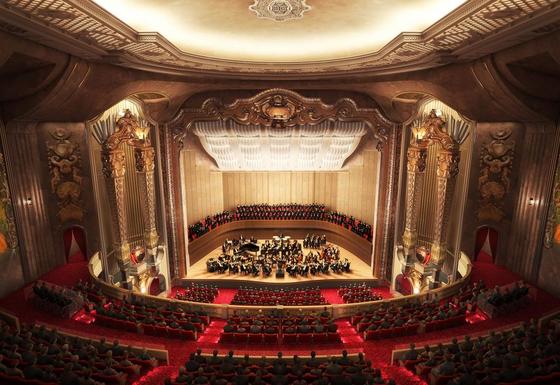
From the Milwaukee Business Journal: The Milwaukee Symphony Orchestra is hoping to restore the historic Warner Grand Theatre on West Wisconsin Avenue in downtown Milwaukee and start performing in the venue in fall 2019.
The acquisition and rehab of the building at 214 W. Wisconsin Ave. is part of a $120 million fundraising effort by the MSO that also will increase its endowment and raise bridge funding, said Mark Niehaus, the group’s president and executive director. The MSO currently plays in the Marcus Center for the Performing Arts on North Water Street, where it is not master of its own scheduling.
Rehabbing the 1930s-era Grand movie theater will let the MSO generate more revenue and become less dependent on donations, Niehaus said. It also will bring thousands of people to West Wisconsin Avenue for weekend performances and contribute to the revitalization of that area of downtown Milwaukee.
“We see ourselves not only fitting into it, we see ourselves as an instigator, as the prime reason people come to West Wisconsin Avenue,” Niehaus said.
The theater is across Wisconsin Avenue from The Shops of Grand Avenue. The owners of that mall are looking to redevelop it into upper-floor office space, a grocery story and a ground-floor marketplace. Bringing more bodies to West Wisconsin Avenue would support that vision.
The MSO tallied $17 million in revenue in its 2015-’16 season, achieving a sales and attendance record, and a balanced budget for three years running. But owning and controlling its own theater space would open more opportunities, Niehaus said.
For starters, the MSO had to stop playing shows in the Marcus Center Dec. 3 to make way for the Milwaukee Ballet’s The Nutcracker 2016. Holiday shows are a big stream of revenue for other symphonies, Niehaus said, citing the $2.2 million earned in December by the Indianapolis Symphony Orchestra.
Also, the MSO can only schedule performances in the Marcus Center 12 to 18 months out, which makes it difficult to book national conductors to come to Milwaukee, Niehaus said.
-
Indianapolis, IN - Owner of historic Rivoli Theatre hits revival milestone

From ibj.com: Supporters of the historic Rivoli Theatre on East 10th Street have hit an important milestone for stabilizing the fragile structure.
The building’s owner, the Rivoli Center for the Performing Arts, announced Monday that it thinks the group has raised enough money to finish installing a new roof.
The not-for-profit received $300,000 through a community development block grant, pushing the total raised to more than $500,000.
Jim Kelly, the group’s president, told Property Lines in an e-mail that members “have fingers crossed hoping this will be enough.”
They plan soon to release the bid package to get estimates from contractors. If all goes well, they hope the entire roof project will be finished by next fall.
It’s been a monumental undertaking to get a roof installed—the first step in saving the building that opened in 1927 as Universal Studios’ first Indiana theater.
The Rivoli Center for the Performing Arts put a new roof over the auditorium portion of the building in May 2014 and will spend a total of nearly $1 million to complete the roof repairs.
-
Lafayette, CA - Park Theater revitalization scrapped

From the East Bay Times: The potential buyers of the Park Theater have pulled out of plans to purchase the empty movie house, ending hopes for its revitalization.
Lafayette residents Cathy and Fred Abbott and business partner Alex McDonald have terminated their efforts to buy the 75-year-old theater on Golden Gate Way they hoped to transform into a performance and rehearsal space, and venue for art house films.
“Simply put, there were too many circumstances making it infeasible for us to return a theater use to this location,” the couple wrote in a Dec. 12 email to city administrators.
-
Visalia, CA - Burst pipe floods historic Visalia Fox Theatre

From abc30.com: Employees of the historic Visalia Fox Theatre are moving forward after suffering a major setback last week.
Thousands of gallons of water flooded the basement and the old orchestra pit last week after a pipe burst. On Monday, theatre officials are still not sure about the extent of the damage.
This isn’t the first time the Fox Theatre has had a flooding issue. About a year ago, an abandoned water line in an exit hallway started leaking into the same basement.
Theatre employees said they’d like to replace their whole plumbing system but that takes a lot of time and money.
Films, concerts, special events – the Visalia Fox Theatre is home to all of the above. But below the stage floor, a very different and unexpected performance was in the works last Wednesday.
A piece of the theatre’s original water pipe burst and caused 15,000 gallons of water to flood the basement. The wave of water worked its way into the old orchestra pit, threatening both their prized organ and hydraulic lift system.
“About an inch from the organ itself,” Erin Olm-Shipman with the theatre said.
Olm-Shipman said they were fortunate that their operations supervisor spotted the problem, but the source of it was not so easy to find. The short-term solution involved using buckets to remove water from the pit and a sump pump to keep the water level from rising in the basement.
“The section of pipe they removed was about right here,” she said, pointing to the location.
Workers had to cut through several layers of wood and concrete to find the affected area and underneath the original stage. And workers had to move quickly because there were events scheduled through the weekend, including a double Tulare County Symphony Holiday performance.
“So, we definitely needed to take care of the flooding, clean up the mess, locate the broken pipe, repair that, repair our stage and get our heating system up as soon as possible, and get running water back in the auditorium as soon as possible,” Olm-Shipman said.
However, the shows went on and were a success. Fox Theatre employees are still waiting to see what insurance can cover but know for a fact the cost of cleaning up and repairing the stage floor will be thousands of dollars. Perhaps, though, it’s simply the price to pay to keep the history of the Fox alive.
“The old girl you never know what she’s going to throw at you,” Olm-Shipman said. “But I think everyone that has been here for a significant amount of time knows that she will throw you something. She will surprise you.”
Employees will be putting in a monitoring system in the basement, which will be connected to their alarm system. That way they’ll be able to respond quickly to any leaks or flooding. They’ll also be testing the organ and lift system for any damage soon.